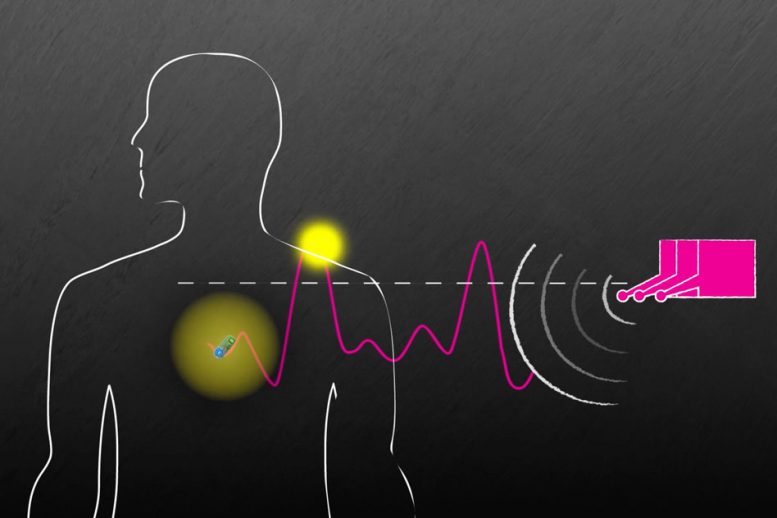
Mit researchers, running with scientists from brigham and ladies’s hospital, have evolved a brand new manner to electricity and communicate with gadgets implanted deep in the human frame. such devices could be used to supply pills, display situations within the frame, or treat disorder via stimulating the mind with energy or mild.
the implants are powered by radio frequency waves, which could properly skip through human tissues. in tests in animals, the researchers confirmed that the waves can electricity devices located 10 centimeters deep in tissue, from a distance of 1 meter.
“even though these tiny implantable devices have no batteries, we can now talk with them from a distance out of doors the body. this opens up totally new styles of scientific applications,” says fadel adib, an assistant professor in mit’s media lab and a senior creator of the paper, so that it will be provided at the affiliation for computing equipment special hobby institution on statistics communique (sigcomm) convention in august.
due to the fact they do no longer require a battery, the devices may be tiny. on this take a look at, the researchers tested a prototype about the scale of a grain of rice, however they anticipate that it could be made even smaller.
wi-fi system powers devices inside the body
mit researchers have developed generation that might be used to remotely cause “clever tablets” to deliver pills.
“having the capability to communicate with these systems without the want for a battery would be a substantial develop. these gadgets might be compatible with sensing situations in addition to aiding within the transport of a drug,” says giovanni traverso, an assistant professor at brigham and women’s medical institution (bwh), harvard clinical school, a studies affiliate at mit’s koch institute for integrative most cancers research, and an writer of the paper.
other authors of the paper are media lab postdoc yunfei ma, media lab graduate pupil zhihong luo, and koch institute and bwh affiliate postdoc christoph steiger.
researchers at mit media lab, harvard medical faculty, and brigham and ladies’s health center have advanced a brand new manner to wirelessly electricity and communicate with gadgets implanted deep in the human body. such gadgets may be used to deliver tablets, reveal situations within the body, or deal with disorder by way of stimulating the mind with electricity or light.
wi-fi communication
clinical devices that may be ingested or implanted inside the frame should offer medical doctors new approaches to diagnose, display, and treat many illnesses. traverso’s lab is now running on a spread of ingestible systems that may be used to deliver pills, screen important symptoms, and come across movement of the gi tract.
in the mind, implantable electrodes that supply an electrical current are used for a way called deep mind stimulation, that's regularly used to treat parkinson’s disorder or epilepsy. these electrodes are actually managed by a pacemaker-like tool implanted underneath the skin, which may be removed if wireless strength is used. wi-fi mind implants could also assist supply light to stimulate or inhibit neuron activity through optogenetics, which to date has no longer been tailored to be used in people however can be beneficial for treating many neurological problems.
currently, implantable medical devices, which include pacemakers, carry their very own batteries, which occupy most of the space at the tool and offer a restricted lifespan. adib, who envisions a lot smaller, battery-loose gadgets, has been exploring the opportunity of wirelessly powering implantable devices with radio waves emitted with the aid of antennas outside the body.
till now, this has been difficult to reap due to the fact radio waves generally tend to deplete as they bypass thru the frame, so they come to be being too susceptible to supply sufficient strength. to conquer that, the researchers devised a system that they call “in vivo networking” (ivn). this system is based on an array of antennas that emit radio waves of barely specific frequencies. because the radio waves tour, they overlap and integrate in specific ways. at positive factors, in which the excessive factors of the waves overlap, they are able to offer enough strength to energy an implanted sensor.
“we chose frequencies which might be barely specific from each different, and in doing so, we realize that at some point in time these are going to attain their highs at the equal time. after they reach their highs at the identical time, they're capable to overcome the energy threshold needed to electricity the tool,” adib says.
with the brand new gadget, the researchers don’t want to recognise the exact place of the sensors in the frame, because the power is transmitted over a large area. this additionally approach that they can strength more than one devices immediately. at the same time that the sensors get hold of a burst of energy, they also get hold of a signal telling them to relay statistics lower back to the antenna. this sign can also be used to stimulate release of a drug, a burst of energy, or a pulse of mild, the researchers say.
wi-fi system electricity gadgets inside the body
in this examine, the researchers examined a prototype approximately the scale of a grain of rice, however they anticipate that it could be made even smaller. picture: courtesy of the researchers
long-distance power
in exams in pigs, the researchers confirmed they may send power from up to a meter outdoor the frame, to a sensor that turned into 10 centimeters deep inside the frame. if the sensors are positioned very near the skin’s floor, they can be powered from up to 38 meters away.
“there’s presently a tradeoff between how deep you can go and the way some distance you can pass out of doors the frame,” adib says.
the researchers are actually operating on making the electricity shipping greater efficient and shifting it over more distances. this era also has the capacity to improve rfid programs in different regions which include inventory manage, retail analytics, and “clever” environments, taking into account longer-distance object tracking and verbal exchange, the researchers say.
Wednesday, June 6, 2018
MIT researchers, working with scientists from Brigham and Women’s Hospital, have developed a new way to power and communicate with devices implanted deep within the human body. through human tissues.
 MIT researchers, working with scientists from Brigham and Women’s Hospital, have developed a new way to power and communicate with devices implanted deep within the human body. through human tissues.
Unknown
5.0
stars based on
35
reviews
Mit researchers, running with scientists from brigham and ladies’s hospital, have evolved a brand new manner to electricity and communica...
MIT researchers, working with scientists from Brigham and Women’s Hospital, have developed a new way to power and communicate with devices implanted deep within the human body. through human tissues.
Unknown
5.0
stars based on
35
reviews
Mit researchers, running with scientists from brigham and ladies’s hospital, have evolved a brand new manner to electricity and communica...

Subscribe to:
Post Comments (Atom)

EmoticonEmoticon