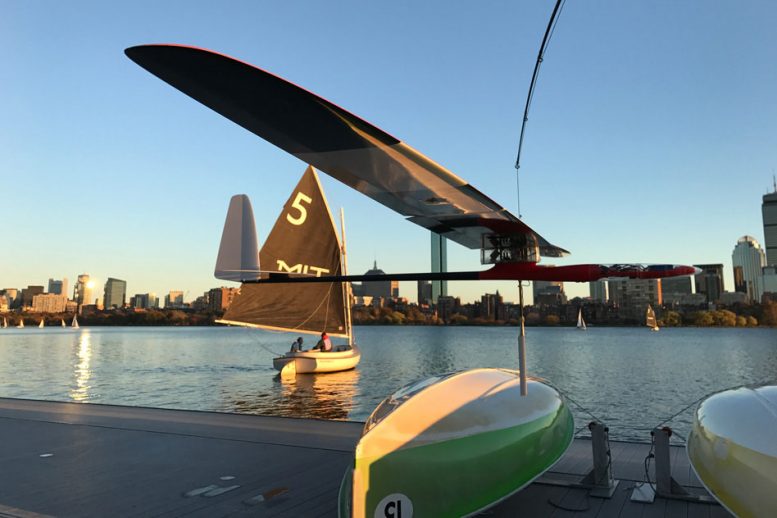
mit engineers have designed a robot glider that can skim alongside the water’s floor, riding the wind like an albatross at the same time as also browsing the waves like a sailboat.
in regions of high wind, the robot is designed to stay aloft, just like its avian counterpart. in which there are calmer winds, the robot can dip a keel into the water to trip like a notably green sailboat alternatively.
the robot device, which borrows from both nautical and biological designs, can cover a given distance the usage of one-1/3 as an awful lot wind as an albatross and touring 10 instances quicker than a normal sailboat. the glider is also rather lightweight, weighing about 6 kilos. the researchers wish that within the close to future, such compact, rapid robot water-skimmers may be deployed in groups to survey huge swaths of the ocean.
“the oceans continue to be vastly undermonitored,” says gabriel bousquet, a former postdoc in mit’s branch of aeronautics and astronautics, who led the layout of the robot as a part of his graduate thesis. “mainly, it’s very important to apprehend the southern ocean and how it's miles interacting with climate change. however it’s very tough to get there. we will now use the power from the surroundings in an green manner to do this long-distance tour, with a gadget that stays small-scale.”
bousquet will gift information of the robotic device this week at ieee’s worldwide conference on robotics and automation, in brisbane, australia. his collaborators on the project are jean-jacques slotine, professor of mechanical engineering and statistics sciences and of brain sciences; and michael triantafyllou, the henry l. and grace doherty professor in ocean technology and engineering.
albatross robot
an albatross glider, designed by mit engineers, skims the charles river.
the physics of speed
remaining year, bousquet, slotine, and triantafyllou posted a take a look at at the dynamics of albatross flight, wherein they recognized the mechanics that allow the tireless traveler to cover significant distances whilst expending minimum power. the key to the hen’s marathon voyages is its potential to journey inside and out of excessive- and coffee-pace layers of air.
mainly, the researchers found the chicken is able to carry out a mechanical procedure referred to as a “transfer of momentum,” wherein it takes momentum from higher, faster layers of air, and with the aid of diving down transfers that momentum to decrease, slower layers, propelling itself while not having to continuously flap its wings.
curiously, bousquet located that the physics of albatross flight could be very just like that of sailboat travel. both the albatross and the sailboat switch momentum so as to keep transferring. however inside the case of the sailboat, that switch happens now not among layers of air, however among the air and water.
“sailboats take momentum from the wind with their sail, and inject it into the water through pushing returned with their keel,” bousquet explains. “that’s how electricity is extracted for sailboats.”
bousquet additionally found out that the velocity at which both an albatross and a sailboat can tour relies upon upon the identical fashionable equation, associated with the switch of momentum. essentially, both the fowl and the boat can tour quicker if they could either live aloft easily or interact with layers, or mediums, of very exclusive speeds.
the albatross does nicely with the previous, as its wings offer herbal lift, even though it flies among air layers with a pretty small difference in windspeeds. meanwhile, the sailboat excels at the latter, traveling among mediums of very distinct speeds — air as opposed to water — although its hull creates a lot of friction and forestalls it from getting a good deal pace. bousquet questioned: what if a car may be designed to carry out well in both metrics, marrying the excessive-speed characteristics of both the albatross and the sailboat?
“we notion, how could we take the first-rate from both worlds?” bousquet says.
out at the water
the group drafted a layout for one of these hybrid automobile, which ultimately resembled an autonomous glider with a three-meter wingspan, much like that of an ordinary albatross. they added a tall, triangular sail, in addition to a narrow, wing-like keel. they then achieved some mathematical modeling to expect how this sort of layout might travel.
consistent with their calculations, the wind-powered automobile could most effective want especially calm winds of approximately 5 knots to zip throughout waters at a speed of about 20 knots, or 23 miles according to hour.
“we located that during light winds you can tour about 3 to ten instances faster than a conventional sailboat, and also you need about half as much wind as an albatross, to attain 20 knots,” bousquet says. “it’s very efficient, and you can journey very speedy, despite the fact that there is not an excessive amount of wind.”
the crew constructed a prototype in their design, the usage of a glider airframe designed with the aid of mark drela, professor of aeronautics and astronautics at mit. to the lowest of the glider they added a keel, at the side of various devices, consisting of gps, inertial size sensors, auto-pilot instrumentation, and ultrasound, to music the height of the glider above the water.
“the goal right here became to expose we will manipulate very exactly how high we are above the water, and that we can have the robotic fly above the water, then right down to wherein the keel can move below the water to generate a force, and the aircraft can nevertheless fly,” bousquet says.
the researchers determined to check this “critical maneuver” — the act of transitioning between flying inside the air and dipping the keel right down to sail in the water. accomplishing this circulate doesn’t always require a sail, so bousquet and his colleagues determined now not to consist of one to be able to simplify preliminary experiments.
in the fall of 2016, the team positioned its design to the test, launching the robotic from the mit sailing pavilion out onto the charles river. as the robot lacked a sail and any mechanism to get it commenced, the team hung it from a fishing rod attached to a whaler boat. with this setup, the boat towed the robotic along the river till it reached approximately 20 miles in keeping with hour, at which point the robotic autonomously “took off,” driving the wind on its own.
as soon as it was flying autonomously, bousquet used a far off manage to present the robot a “down” command, prompting it to dip low sufficient to submerge its keel inside the river. next, he adjusted the route of the keel, and determined that the robot changed into in a position to persuade far from the boat as predicted. he then gave a command for the robot to fly lower back up, lifting the keel out of the water.
“we were flying very close to the surface, and there was little or no margin for error — the whole lot had to be in place,” bousquet says. “so it become very high strain, but very exciting.”
the experiments, he says, show that the team’s conceptual device can tour efficiently, powered by using the wind and the water. subsequently, he envisions fleets of such vehicles autonomously and effectively monitoring big expanses of the sea.
“believe you can fly like an albatross when it’s actually windy, after which while there’s now not enough wind, the keel permits you to sail like a sailboat,” bousquet says. “this dramatically expands the styles of areas wherein you could pass.”



EmoticonEmoticon