bolometers, gadgets that display electromagnetic radiation thru heating of an soaking up material, are utilized by astronomers and homeowners alike. but most such gadgets have confined bandwidth and have to be operated at ultralow temperatures. now, researchers say they’ve located a ultrafast but fairly touchy opportunity which can paintings at room temperature — and can be tons less high priced.
the findings, published today inside the magazine nature nanotechnology, should help pave the way closer to new varieties of astronomical observatories for long-wavelength emissions, new warmness sensors for buildings, or even new varieties of quantum sensing and facts processing devices, the multidisciplinary research group says. the organization includes latest mit postdoc dmitri efetov, professor dirk englund of mit’s branch of electrical engineering and laptop technological know-how, kin chung fong of raytheon bbn technology, and colleagues from mit and columbia college.
“we consider that our paintings opens the door to new forms of efficient bolometers based totally on low-dimensional substances,” says englund, the paper’s senior writer. he says the brand new gadget, based on the heating of electrons in a small piece of a -dimensional form of carbon called graphene, for the first time combines both high sensitivity and high bandwidth — orders of significance more than that of conventional bolometers — in a single tool.
“the brand new tool may be very sensitive, and at the equal time ultrafast,” having the ability to take readings in only picoseconds (trillionths of a second), says efetov, now a professor at icfo, the institute of photonic sciences in barcelona, spain, who is the paper’s lead writer. “this aggregate of residences is unique,” he says.
the new system also can perform at any temperature, he says, not like present day devices that must be cooled to extraordinarily low temperatures. although most actual packages of the device could nonetheless be finished under those ultracold situations, for a few packages, along with thermal sensors for building efficiency, the capability to perform with out specialised cooling systems might be a real plus. “that is the primary tool of this kind that has no restriction on temperature,” efetov says.
the new bolometer they built, and tested underneath laboratory situations, can degree the whole power carried by way of the photons of incoming electromagnetic radiation, whether or not that radiation is inside the form of visible light, radio waves, microwaves, or other components of the spectrum. that radiation can be coming from distant galaxies, or from the infrared waves of heat escaping from a poorly insulated house.
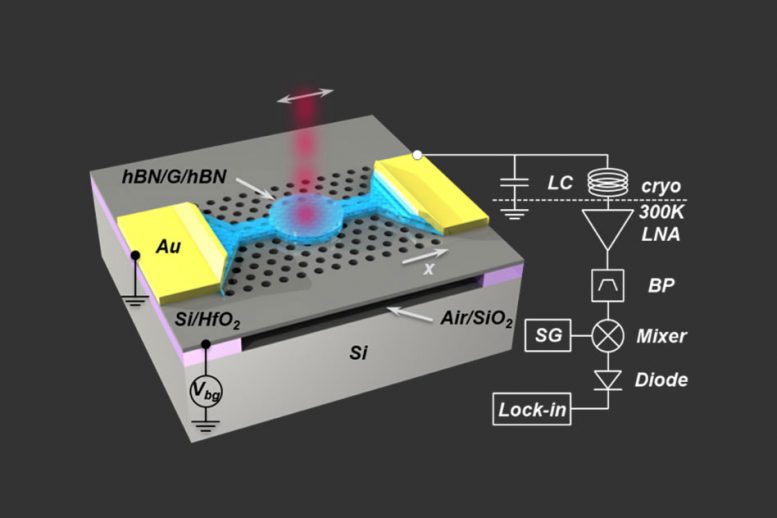
the device is completely exceptional from traditional bolometers, which generally use a steel to soak up the radiation and measure the resulting temperature upward thrust. as a substitute, this team developed a new form of bolometer that is based on heating electrons moving in a small piece of graphene, in preference to heating a solid steel. the graphene is coupled to a device called a photonic nanocavity, which serves to expand the absorption of the radiation, englund explains.
“maximum bolometers depend upon the vibrations of atoms in a bit of cloth, which has a tendency to make their response slow,” he says. in this case, though, “unlike a traditional bolometer, the heated body here is simply the electron gasoline, which has a totally low warmness potential, meaning that even a small strength input because of absorbed photons reasons a large temperature swing,” making it simpler to make specific measurements of that strength. despite the fact that graphene bolometers had formerly been validated, this paintings solves a number of the critical first-rate challenges, including green absorption into the graphene using a nanocavity, and the impedance-matched temperature readout.
the brand new technology, englund says, “opens a brand new window for bolometers with completely new functionalities that would greatly improve thermal imaging, observational astronomy, quantum records, and quantum sensing, among other applications.”
for astronomical observations, the brand new machine could assist by using filling in some of the closing wavelength bands that have no longer yet had sensible detectors to make observations, along with the “terahertz gap” of frequencies that are very hard to pick out up with present systems. “there, our detector might be a modern-day device” for gazing these elusive rays, efetov says. it can be beneficial for observing the very lengthy-wavelength cosmic history radiation, he says.
daniel prober, a professor of carried out physics at yale university who become no longer involved on this studies, says, “this work is a excellent task to make use of the many benefits of the ultrathin metal layer, graphene, whilst cleverly running around the obstacles that could in any other case be imposed with the aid of its accomplishing nature.” he adds, “the resulting detector is extraordinarily touchy for energy detection in a hard place of the spectrum, and is now ready for some exciting packages.”
and robert hadfield, a professor of photonics on the university of glasgow, who also become no longer concerned on this paintings, says, “there is massive call for for brand spanking new excessive-sensitivity infrared detection technologies. this work with the aid of efetov and co-employees reporting an modern graphene bolometer incorporated in a photonic crystal hollow space to achieve excessive absorption is timely and exciting.”
Tuesday, June 19, 2018
Graphene Bolometer is Faster, Simpler and Covers More WavelengthsSchematic illustration of the experimental setup Image courtesy of the researchers magazina nature
 Graphene Bolometer is Faster, Simpler and Covers More WavelengthsSchematic illustration of the experimental setup Image courtesy of the researchers magazina nature
Unknown
5.0
stars based on
35
reviews
bolometers, gadgets that display electromagnetic radiation thru heating of an soaking up material, are utilized by astronomers and homeowne...
Graphene Bolometer is Faster, Simpler and Covers More WavelengthsSchematic illustration of the experimental setup Image courtesy of the researchers magazina nature
Unknown
5.0
stars based on
35
reviews
bolometers, gadgets that display electromagnetic radiation thru heating of an soaking up material, are utilized by astronomers and homeowne...

Subscribe to:
Post Comments (Atom)

EmoticonEmoticon