era captures water evaporating from cooling towers; prototype to be hooked up on mit’s crucial software plant.
a new device devised with the aid of mit engineers should provide a low-fee source of drinking water for parched towns around the sector even as also slicing energy plant working charges.
approximately 39 percentage of all of the fresh water withdrawn from rivers, lakes, and reservoirs inside the u.s. is earmarked for the cooling desires of electric power flora that use fossil fuels or nuclear energy, and plenty of that water ends up floating away in clouds of vapor. but the new mit gadget should potentially store a tremendous fraction of that lost water — and will even end up a sizeable supply of easy, secure ingesting water for coastal towns wherein seawater is used to cool nearby strength vegetation.
the precept behind the brand new idea is deceptively simple: while air that’s wealthy in fog is zapped with a beam of electrically charged debris, called ions, water droplets end up electrically charged and for this reason may be drawn in the direction of a mesh of wires, much like a window display screen, positioned in their direction. the droplets then acquire on that mesh, drain down into a gathering pan, and may be reused within the power plant or despatched to a city’s water deliver system.
the machine, that is the premise for a startup agency known as infinite cooling that final month won mit’s $100k entrepreneurship opposition, is described in a paper published these days in the journal science advances, co-authored by way of maher damak phd ’18 and accomplice professor of mechanical engineering kripa varanasi. damak and varanasi are a number of the co-founders of the startup.
varanasi’s vision become to develop distinctly efficient water restoration structures by means of capturing water droplets from each herbal fog and plumes of industrial cooling towers. the assignment started out as part of damak’s doctoral thesis, which aimed to enhance the efficiency of fog-harvesting structures that are used in many water-scarce coastal regions as a source of potable water. the ones structures, which usually include some form of plastic or metal mesh hung vertically inside the course of fogbanks that frequently roll in from the ocean, are extremely inefficient, taking pictures only approximately 1 to three percent of the water droplets that skip thru them. varanasi and damak puzzled if there has been a manner to make the mesh seize greater of the droplets — and located a totally simple and powerful manner of doing so.
the cause for the inefficiency of current systems became apparent inside the crew’s unique lab experiments: the problem is in the aerodynamics of the device. as a circulation of air passes an impediment, including the wires in those mesh fog-catching screens, the airflow certainly deviates around the impediment, tons as air flowing around an airplane wing separates into streams that skip above and underneath the wing structure. those deviating airstreams convey droplets that have been heading closer to the twine off to the side, until they had been headed bang-on towards the twine’s middle.
the end result is that the fraction of droplets captured is some distance lower than the fraction of the collection location occupied with the aid of the wires, because droplets are being swept apart from wires that lie in front of them. simply making the wires larger or the areas within the mesh smaller tends to be counterproductive as it hampers the general airflow, ensuing in a net decrease in series.
new machine for low fee source of drinking water
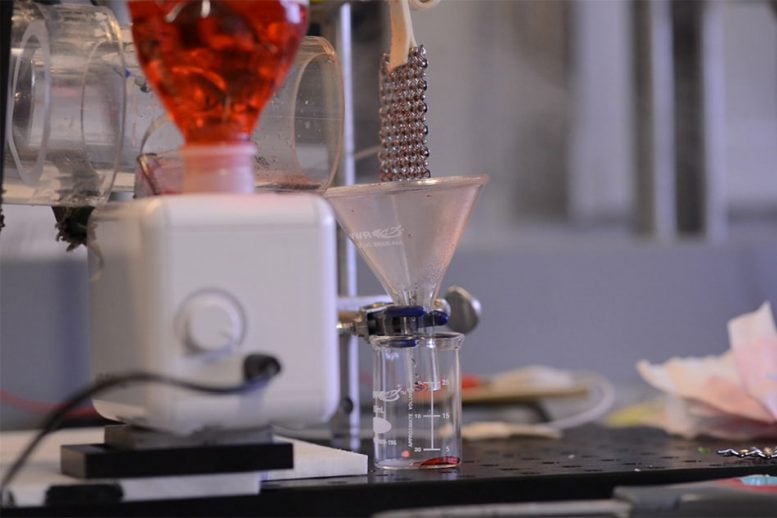
the team’s lab setup became used to test the powerplant condenser device. the mesh is located above the funnel at proper to collect the water that condenses on the mesh. courtesy of researchers
however whilst the incoming fog gets zapped first with an ion beam, the opposite effect takes place. no longer handiest do all of the droplets which can be in the route of the wires land on them, even droplets that had been aiming for the holes within the mesh get pulled toward the wires. this device can for this reason capture a far larger fraction of the droplets passing thru. as such, it may dramatically enhance the performance of fog-catching structures, and at a fantastically low fee. the device is straightforward, and the quantity of electricity required is minimum.
subsequent, the crew centered on taking pictures water from the plumes of electricity plant cooling towers. there, the circulation of water vapor is lots more focused than any clearly taking place fog, and that makes the device even extra green. and considering taking pictures evaporated water is in itself a distillation manner, the water captured is pure, even though the cooling water is salty or contaminated. at this factor, karim khalil, every other graduate student from varanasi’s lab joined the crew.
“it’s distilled water, that is of higher satisfactory, that’s now just wasted,” says varanasi. “that’s what we’re trying to seize.” the water can be piped to a metropolis’s consuming water device, or used in procedures that require natural water, inclusive of in a electricity plant’s boilers, in preference to being utilized in its cooling machine in which water first-class doesn’t count an awful lot.
a typical 600-megawatt power plant, varanasi says, could capture one hundred fifty million gallons of water a yr, representing a cost of hundreds of thousands of greenbacks. this represents about 20 to 30 percent of the water misplaced from cooling towers. with in addition refinements, the system may be capable of capture even greater of the output, he says.
what’s greater, in view that electricity flowers are already in location along many arid coastlines, and lots of them are cooled with seawater, this presents a totally easy way to provide water desalination offerings at a tiny fraction of the price of building a standalone desalination plant. damak and varanasi estimate that the installation price of this sort of conversion would be about one-third that of a building a new desalination plant, and its operating fees might be about 1/50. the payback time for installing any such machine might be approximately years, varanasi says, and it would have essentially no environmental footprint, including nothing to that of the unique plant.
“this can be a first-rate technique to cope with the global water disaster,” varanasi says. “it could offset the want for about 70 percent of new desalination plant installations within the subsequent decade.”
in a chain of dramatic evidence-of-idea experiments, damak, khalil, and varanasi demonstrated the concept by constructing a small lab model of a stack emitting a plume of water droplets, much like those visible on real energy plant cooling towers, and located their ion beam and mesh display on it. in video of the test, a thick plume of fog droplets is seen growing from the tool — and nearly instantly disappears as soon because the machine is switched on.
the team is currently building a full-scale take a look at model of their system to be placed on the cooling tower of mit’s relevant application plant, a herbal-fuel cogeneration power plant that offers most of the campus’ electricity, heating, and cooling. the setup is anticipated to be in region by the stop of the summer and could undergo trying out in the fall. the exams will include trying one of a kind variations of the mesh and its supporting structure, damak says.
that ought to offer the needed proof to enable energy plant operators, who tend to be conservative of their technology selections, to adopt the machine. because electricity vegetation have decades-lengthy operating lifetimes, their operators have a tendency to “be very chance-averse” and want to recognize “has this been done some other place?” varanasi says. the campus strength plant exams will not most effective “de-chance” the era, but may even assist the mit campus improve its water footprint, he says. “this will have a high impact on water use on campus.”
Tuesday, June 19, 2018
Engineers Develop New System to Provide Low-Cost Drinking Water sizeeable supply of easy
 Engineers Develop New System to Provide Low-Cost Drinking Water sizeeable supply of easy
Unknown
5.0
stars based on
35
reviews
era captures water evaporating from cooling towers; prototype to be hooked up on mit’s crucial software plant. a new device devised with ...
Engineers Develop New System to Provide Low-Cost Drinking Water sizeeable supply of easy
Unknown
5.0
stars based on
35
reviews
era captures water evaporating from cooling towers; prototype to be hooked up on mit’s crucial software plant. a new device devised with ...

Subscribe to:
Post Comments (Atom)

EmoticonEmoticon