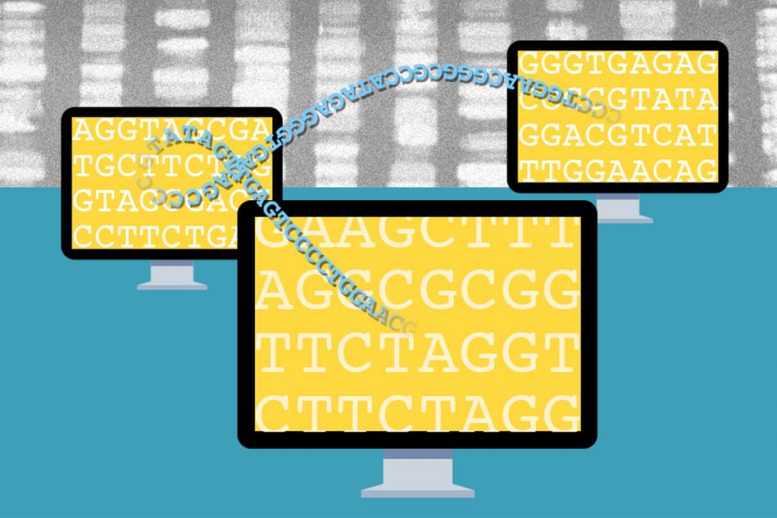
genome-extensive association research, which look for links among particular genetic versions and occurrence of sickness, are the premise of a whole lot cutting-edge biomedical research.
however databases of genomic records pose privacy dangers. from human beings’s uncooked genomic records, it is able to be feasible to infer their surnames and perhaps even the shapes of their faces. many human beings are reluctant to make a contribution their genomic data to biomedical research initiatives, and an corporation web hosting a huge repository of genomic statistics would possibly behavior a months-lengthy assessment earlier than deciding whether to furnish a researcher’s request for get right of entry to.
in a paper performing nowadays in nature biotechnology, researchers from mit and stanford university gift a brand new system for defensive the privacy of individuals who make a contribution their genomic information to large-scale biomedical research. in which earlier cryptographic techniques have been so computationally intensive that they have become prohibitively time consuming for a range of thousand genomes, the brand new system promises green privateness protection for studies conducted over as many as a million genomes.
“as biomedical researchers, we’re pissed off with the aid of the lack of statistics and by the get entry to-controlled repositories,” says bonnie berger, the simons professor of arithmetic at mit and corresponding writer at the paper. “we assume a destiny with a landscape of massively dispensed genomic information, wherein non-public people take ownership in their very own non-public genomes, and institutes as well as hospitals build their own private genomic databases. our work provides a roadmap for pooling together this enormous amount of genomic information to enable scientific development.”
the primary creator at the paper is hyunghoon cho, a graduate scholar in electrical engineering and laptop technology at mit; he and berger are joined through david wu, a graduate student in computer technological know-how at stanford.
at the middle of the machine is a way referred to as secret sharing, which divides touchy statistics amongst more than one servers. to save the quantity x, as an instance, a mystery-sharing gadget might send the random quantity r to at least one server and x-r to the other.
neither server is independently capable to deduce x. collectively, but, they could nevertheless perform useful operations. if one server stored a bunch of r’s and added them collectively, and the other introduced up all the corresponding (x-r)’s, then sharing the effects and including them collectively could yield the sum of all of the x’s. neither server, but, could ever look at the cost of any one x.
if both servers are hacked, of route, the attacker ought to reconstruct all of the x’s. however so long as one server is sincere, the gadget is comfy. moreover, that principle generalizes to multiple servers. if statistics are divided among, say, four servers, an attacker might have to infiltrate all 4; hacking any 3 is inadequate to extract any information.
on this context, but, multiplication is greater complex than addition. multiplying x’s requires the generation of 3 extra random numbers — referred to as a beaver triple, after the cryptographer donald beaver — in addition to the r’s. the ones 3 numbers, in turn, need to be divided amongst servers using mystery sharing. including the name of the game-shared additives of those numbers to the x’s and r’s before multiplication offers rise to an algebraic expression wherein all the delivered randomness may be filtered out, leaving handiest the product of the 2 x’s.
genome-extensive association research involve a huge table — or matrix — that maps the genomes inside the database against the places of genetic variations called snps, for unmarried-nucleotide polymorphisms. the snps will typically quantity about one million, so if the database carries a million genomes, the result can be one million-by means of-million matrix.
finding useful disorder correlations requires filtering out deceptive correlations, a method known as populace stratification correction. east asians, for instance, are often lactose intolerant, however they also have a tendency to be shorter than northern europeans. a naïve investigation of the genetic correlates of lactose intolerance would possibly instead grow to be figuring out the ones for top.
population stratification correction commonly relies on an algorithm referred to as primary aspect evaluation, which calls for repeated multiplications involving the whole snp-as opposed to-genome matrix. if every access in the matrix wished its personal set of beaver triples for each of these multiplications, analyzing a million genomes could be prohibitively time consuming.
but cho, berger, and wu found a way to shape that collection of multiplications so that most of the beaver triples can be calculated best as soon as and reused, drastically lowering the complexity of the computation.
additionally they use a pair other techniques to speed up their device. because the beaver triples need to be shared secretly, every number inside the beaver triple has an related random number: in the -server state of affairs, one server could get the random quantity and the opposite would get the beaver variety minus the random wide variety.
in cho, berger, and wu’s machine, there’s a server devoted to producing beaver triples and sharing them secretly. but while it wishes to transmit the beaver numbers minus the related random numbers to the correct servers, it doesn’t need to transmit the random numbers themselves. as a substitute, it honestly stocks the quantity it uses to “seed” an algorithm referred to as a pseudorandom number generator. the recipient servers can then generate the random numbers on their very own, saving a big quantity of conversation bandwidth.
ultimately, when acting all its multiplications, the gadget doesn’t actually use the complete million-with the aid of-million matrix. instead, it uses an approximation method known as random projection to winnow the matrix down while preserving the accuracy of the final computation outcomes.
based on these techniques, cho, berger, and wu’s device correctly reproduced three published genome-wide affiliation studies involving 23,000 individual genomes. the effects of those analyses endorse that the gadget ought to scale efficaciously to 1,000,000 genomes.
Sunday, June 24, 2018
Cryptographic System Could Enable Crowdsourced Genomics genomic data uncooked
 Cryptographic System Could Enable Crowdsourced Genomics genomic data uncooked
Unknown
5.0
stars based on
35
reviews
genome-extensive association research, which look for links among particular genetic versions and occurrence of sickness, are the premise o...
Cryptographic System Could Enable Crowdsourced Genomics genomic data uncooked
Unknown
5.0
stars based on
35
reviews
genome-extensive association research, which look for links among particular genetic versions and occurrence of sickness, are the premise o...

Subscribe to:
Post Comments (Atom)

EmoticonEmoticon