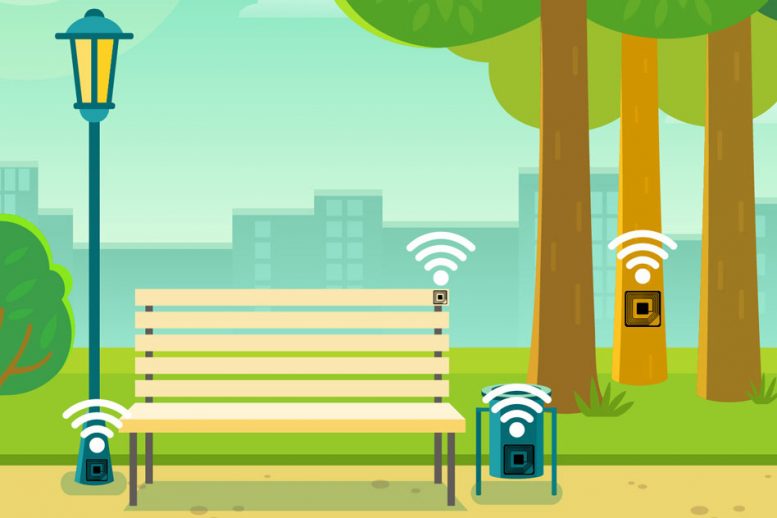
nowadays, many stores and manufacturers are tracking their products the use of rfid, or radio-frequency identity tags. often, these tags come within the shape of paper-based labels outfitted with a simple antenna and memory chip. whilst slapped on a milk carton or jacket collar, rfid tags act as smart signatures, transmitting statistics to a radio-frequency reader about the identification, kingdom, or vicinity of a given product.
similarly to preserving tabs on merchandise at some point of a deliver chain, rfid tags are used to trace the whole lot from casino chips and cattle to entertainment park site visitors and marathon runners.
the car-identification lab at mit has lengthy been at the vanguard of developing rfid technology. now engineers in this institution are flipping the generation toward a brand new function: sensing. they have got advanced a brand new ultra-high-frequency, or uhf, rfid tag-sensor configuration that senses spikes in glucose and wirelessly transmits this facts. in the future, the team plans to tailor the tag to experience chemical substances and gases inside the environment, together with carbon monoxide.
“human beings are looking towards more packages like sensing to get greater fee out of the prevailing rfid infrastructure,” says sai nithin reddy kantareddy, a graduate student in mit’s branch of mechanical engineering. “believe creating hundreds of these less expensive rfid tag sensors which you could just slap onto the walls of an infrastructure or the encircling gadgets to locate not unusual gases like carbon monoxide or ammonia, while not having a further battery. you can deploy those affordably, over a huge network.”
kantareddy developed the sensor with rahul bhattacharya, a studies scientist within the organization, and sanjay sarma, the fred citadel flowers and daniel citadel plant life professor of mechanical engineering and vice chairman of open getting to know at mit. the researchers provided their design on the ieee worldwide convention on rfid, and their consequences appear on line this week.
“rfid is the most inexpensive, lowest-power rf communication protocol available,” sarma says. “whilst accepted rfid chips may be deployed to sense the real international thru tricks in the tag, real pervasive sensing can become fact.”
confounding waves
presently, rfid tags are available in a number of configurations, such as battery-assisted and “passive” varieties. both varieties of tags contain a small antenna which communicates with a far flung reader by backscattering the rf sign, sending it a easy code or set of facts that is saved in the tag’s small incorporated chip. battery-assisted tags include a small battery that powers this chip. passive rfid tags are designed to reap power from the reader itself, which naturally emits simply sufficient radio waves inside fcc limits to power the tag’s memory chip and get hold of a contemplated signal.
lately, researchers were experimenting with approaches to show passive rfid tags into sensors that could function over lengthy stretches of time without the need for batteries or replacements. those efforts have typically centered on manipulating a tag’s antenna, engineering it in this type of manner that its electrical residences alternate in reaction to certain stimuli within the surroundings. as a result, an antenna ought to replicate radio waves again to a reader at a generally special frequency or signal-energy, indicating that a positive stimuli has been detected.
for example, sarma’s organization formerly designed an rfid tag-antenna that modifications the manner it transmits radio waves in response to moisture content material inside the soil. the group additionally fabricated an antenna to feel signs and symptoms of anemia in blood flowing across an rfid tag.
but kantareddy says there are drawbacks to such antenna-centric designs, the primary one being “multipath interference,” a confounding effect in which radio waves, even from a single source such as an rfid reader or antenna, can mirror off a couple of surfaces.
“relying at the environment, radio waves are reflecting off partitions and gadgets earlier than they reflect off the tag, which interferes and creates noise,” kantareddy says. “with antenna-based sensors, there’s greater danger you’ll get fake positives or negatives, meaning a sensor will let you know it sensed some thing even if it didn’t, because it’s suffering from the interference of the radio fields. so it makes antenna-based sensing a little much less reliable.”
chipping away
sarma’s organization took a new technique: as opposed to manipulating a tag’s antenna, they attempted tailoring its reminiscence chip. they bought off-the-shelf integrated chips which can be designed to replace between one-of-a-kind energy modes: an rf power-based mode, much like fully passive rfids; and a neighborhood energy-assisted mode, inclusive of from an external battery or capacitor, just like semipassive rfid tags.
the team labored each chip into an rfid tag with a trendy radio-frequency antenna. in a key step, the researchers constructed a simple circuit around the memory chip, permitting the chip to exchange to a neighborhood power-assisted mode only when it senses a positive stimuli. while in this assisted mode (commercially called battery-assisted passive mode, or bap), the chip emits a brand new protocol code, awesome from the normal code it transmits whilst in a passive mode. a reader can then interpret this new code as a sign that a stimuli of interest has been detected.
kantareddy says this chip-based design can create extra reliable rfid sensors than antenna-based totally designs as it basically separates a tag’s sensing and communique talents. in antenna-primarily based sensors, each the chip that shops data and the antenna that transmits statistics are dependent on the radio waves pondered within the surroundings. with this new design, a chip does not need to rely on confounding radio waves if you want to experience some thing.
“we are hoping reliability in the facts will increase,” kantareddy says. “there’s a brand new protocol code in conjunction with the extended sign power whenever you’re sensing, and there’s much less risk a good way to confuse when a tag is sensing as opposed to not sensing.”
“this method is exciting because it also solves the problem of records overload that may be related to massive numbers of tags inside the surroundings,” bhattacharyya says. “in place of constantly having to parse through streams of records from quick-range passive tags, an rfid reader may be positioned far sufficient away so that best occasions of importance are communicated and want to be processed.”
“plug-and-play” sensors
as a demonstration, the researchers advanced an rfid glucose sensor. they set up commercially available glucose-sensing electrodes, full of the electrolyte glucose oxidase. when the electrolyte interacts with glucose, the electrode produces an electric powered fee, acting as a nearby power supply, or battery.
the researchers connected these electrodes to an rfid tag’s reminiscence chip and circuit. once they brought glucose to each electrode, the ensuing price brought about the chip to replace from its passive rf energy mode, to the neighborhood rate-assisted strength mode. the more glucose they brought, the longer the chip stayed on this secondary strength mode.
kantareddy says that a reader, sensing this new strength mode, can interpret this as a sign that glucose is gift. the reader can potentially decide the amount of glucose via measuring the time throughout which the chip stays within the battery-assisted mode: the longer it stays on this mode, the extra glucose there should be.
whilst the group’s sensor become able to discover glucose, its overall performance turned into below that of commercially available glucose sensors. the aim, kantareddy says, was not always to increase an rfid glucose sensor, however to reveal that the institution’s layout could be manipulated to experience something more reliably than antenna-based totally sensors.
“with our layout, the statistics is extra trustable,” kantareddy says.
the design is likewise greater efficient. a tag can run passively on rf strength reflected from a close-by reader till a stimuli of hobby comes around. the stimulus itself produces a price, which powers a tag’s chip to send an alarm code to the reader. the very act of sensing, consequently, produces extra electricity to electricity the incorporated chip.
“because you’re getting strength from rf and your electrodes, this increases your conversation variety,” kantareddy says. “with this layout, your reader can be 10 meters away, in preference to 1 or 2. this can lower the quantity and value of readers that, say, a facility calls for.”
going forward, he plans to increase an rfid carbon monoxide sensor by combining his layout with one of a kind varieties of electrodes engineered to provide a price in the presence of the gas.
“with antenna-based designs, you have to design specific antennas for specific packages,” kantareddy says. “with ours, you could simply plug and play with these commercially available electrodes, which makes this complete concept scalable. then you can install loads or heaps, in your own home or in a facility in which you may reveal boilers, gas boxes, or pipes.”



 a threat to interchange to renewable assets for heating, electricity and gas, while additionally providing new opportunities for several industries to supply massive numbers of renewable products. this is the decision of researchers from chalmers college of generation, sweden, who now, after ten years of strength studies into gasification of biomass, see an array of latest technological achievements.