a brand new transparent, bioinspired coating makes ordinary glass hard, self-cleaning, and relatively slippery, a crew from harvard university said on-line july 31 in nature communications.
the new coating might be used to create long lasting, scratch-resistant lenses for eyeglasses, self-cleaning windows, stepped forward solar panels, and new medical diagnostic gadgets, stated important investigator joanna aizenberg, the amy smith berylson professor of materials technological know-how within the harvard school of engineering and implemented sciences (seas), a core faculty member at the wyss institute for biologically inspired engineering, and professor of chemistry and chemical biology.
the new coating builds on an award-winning technology pioneered by way of aizenberg and her team called slippery liquid-infused porous surfaces (slips) — the slipperiest synthetic floor regarded. the new coating is equally slippery, but a great deal more long lasting and fully obvious. collectively those advances clear up longstanding demanding situations in developing commercially beneficial materials that repel nearly the whole thing.
researchers create ultraslippery coating for glass
the tiny, tightly packed cells of the honeycomb structure, shown right here in this electron micrograph, make the slips coating fairly durable.
slips was stimulated with the aid of the slick approach of the carnivorous pitcher plant, which lures bugs onto the ultraslippery surface of its leaves, wherein they slide to their doom. unlike earlier water-repelling substances, slips repels oil and sticky drinks like honey, and it resists ice formation and bacterial biofilms as well.
while slips was an crucial boost, it turned into additionally “a evidence of principle” — step one towards a commercially precious generation, stated lead creator nicolas vogel, a postdoctoral fellow in applied physics at seas.
“slips repels each oily and aqueous beverages however it’s steeply-priced to make and now not transparent,” vogel stated.
the unique slips substances additionally need to be fixed somehow to existing surfaces, which is regularly tough.
“it might be easier to take the prevailing surface and treat it in a positive way to make it slippery,” vogel defined.
materials scientists at harvard university have created an ultraslippery cloth referred to as slips. those high-quality-repellent, transparent home windows can efficaciously repel wine, olive oil, and ketchup, at the same time as the surrounding surfaces come to be notably stained. the cloth additionally resists heavy-duty oil, water, and ice.
vogel, aizenberg, and their colleagues sought to increase a coating that completed this and worked as slips does. slips’ skinny layer of liquid lubricant permits beverages to glide effortlessly over the floor, plenty as a skinny layer of water in an ice rink facilitates an ice skater flow.
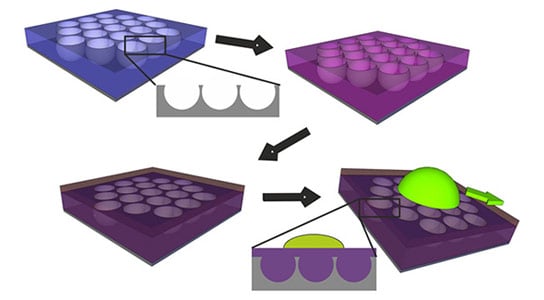
to create a slips-like coating, the researchers corral a set of tiny spherical debris of polystyrene, the principle factor of styrofoam, on a flat glass floor like a collection of pingpong balls. they pour liquid glass on them until the balls are extra than half buried. after the glass solidifies, they burn away the beads, leaving a network of craters that resembles a honeycomb. they then coat that honeycomb with the identical liquid lubricant used in slips to create a tough however slippery coating.
“the honeycomb shape is what confers the mechanical balance to the new coating,” stated aizenberg.
by means of adjusting the width of the honeycomb cells to make their diameter a whole lot smaller than the wavelength of visible light, the researchers kept the coating from reflecting light. this made a tumbler slide with the coating completely obvious.
the covered glass slides repelled a variety of drinks, just as slips does, which include water, octane, wine, olive oil and ketchup. and, like slips, the coating reduced the adhesion of ice to a glass slide through ninety nine percent. retaining materials frost-unfastened is important, given that adhered ice can take down strength strains, decrease the electricity efficiency of cooling systems, put off airplanes, and lead buildings to collapse.
importantly, the honeycomb shape of the slips coating on the glass slides confers unrivaled mechanical robustness. it withstood harm and remained slippery after remedies that often scratched and compromised regular glass surfaces and other popular liquid-repellent substances, inclusive of touching, peeling off a chunk of tape, and wiping with a tissue.
“we set ourselves a tough goal: to design a flexible coating that’s as appropriate as slips however much less complicated to apply, obvious, and plenty tougher — and that's what we controlled,” aizenberg said.
the team is now honing its approach to better coat curved portions of glass in addition to clear plastics inclusive of plexiglas, and to evolve the approach for the pains of producing.
“joanna’s new slips coating reveals the energy of following nature’s lead in growing new technologies,” said donald e. ingber, founding director of the wyss institute, professor of bioengineering at seas, and judah folkman professor of vascular biology at harvard medical school and boston kids’s hospital, a harvard affiliate. “we are enthusiastic about the range of applications that might use this innovative coating.”
this paintings turned into funded by way of the advanced research initiatives corporation — power (arpa-e), the air pressure workplace of medical research, and the wyss institute. vogel acquired investment from the leopoldina fellowship software. further to vogel and aizenberg, the studies crew covered: rebecca a. belisle, a former wyss research assistant who is now a graduate student in substances technological know-how and engineering at stanford university; benjamin hatton, previously a studies appointee at seas and a era improvement fellow at the wyss institute who is now an assistant professor of materials technological know-how and engineering on the college of toronto; and tak-sing wong, a former postdoctoral research fellow on the wyss institute who is now an assistant professor of mechanical and nuclear engineering at pennsylvania country college.
Tuesday, July 31, 2018
New ‘Superglass’ Coating Repels Liquids and is Capable of Self-Repair aizenberg the amy smith berylson professor of materials.
 New ‘Superglass’ Coating Repels Liquids and is Capable of Self-Repair aizenberg the amy smith berylson professor of materials.
Unknown
5.0
stars based on
35
reviews
a brand new transparent, bioinspired coating makes ordinary glass hard, self-cleaning, and relatively slippery, a crew from harvard univers...
New ‘Superglass’ Coating Repels Liquids and is Capable of Self-Repair aizenberg the amy smith berylson professor of materials.
Unknown
5.0
stars based on
35
reviews
a brand new transparent, bioinspired coating makes ordinary glass hard, self-cleaning, and relatively slippery, a crew from harvard univers...

Subscribe to:
Post Comments (Atom)
EmoticonEmoticon