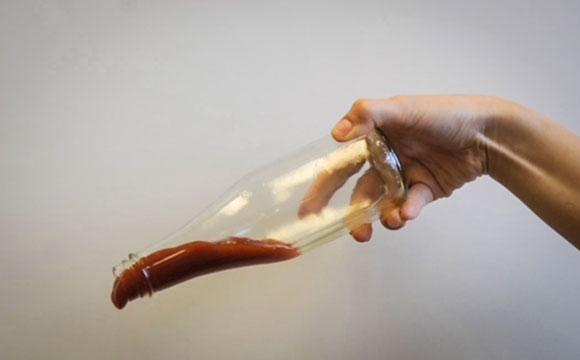
the days of wasting condiments — and other products — that stick stubbornly to the perimeters of their bottles can be long past, way to mit spinout liquiglide, which has licensed its nonstick coating to a prime customer-items enterprise.
evolved in 2009 by means of mit’s kripa varanasi and david smith, liquiglide is a liquid-impregnated coating that acts as a slippery barrier among a floor and a viscous liquid. implemented interior a condiment bottle, as an example, the coating clings completely to its aspects, at the same time as allowing the condiment to glide off absolutely, and not using a residue.
in 2012, amidst a flurry of media attention following liquiglide’s access in mit’s $100k entrepreneurship opposition, smith and varanasi founded the startup — with assist from the institute — to commercialize the coating.
today, norwegian consumer-items producer orkla has signed a licensing settlement to apply the liquiglide’s coating for mayonnaise merchandise offered in germany, scandinavia, and numerous different eu international locations. this comes on the heels of every other licensing deal, with elmer’s, introduced in march.
but that is most effective the start, says varanasi, an companion professor of mechanical engineering who is now on liquiglide’s board of directors and chief technological know-how consultant. the startup, which simply entered the customer-goods marketplace, is dating offers with severa producers of meals, splendor supplies, and household products. “our coatings can work with a whole variety of products, due to the fact we can tailor each coating to meet the specific requirements of every utility,” varanasi says.
study the science behind liquiglide’s completely wet coating and notice it in motion. video: melanie gonick/mit
aside from supplying financial savings and comfort, liquiglide targets to reduce the surprising amount of wasted products — especially meals — that persist with field aspects and get tossed. as an example, in 2009 customer reviews observed that up to fifteen percentage of bottled condiments are in the end thrown away. retaining bottles easy, varanasi adds, may also significantly cut the usage of water and strength, in addition to the charges associated with rinsing bottles earlier than recycling. “it has big potential in terms of essential sustainability,” he says.
varanasi says liquiglide pursuits next to tackle buildup in oil and gasoline pipelines, that may cause corrosion and clogs that lessen float. destiny uses, he provides, ought to include coatings for medical devices such as catheters, deicing roofs and airplane wings, and enhancing manufacturing and technique performance. “interfaces are ubiquitous,” he says. “we need to be anywhere.”
liquid-impregnated surfaces
liquiglide became initially advanced at the same time as smith labored on his graduate research in varanasi’s studies institution. smith and varanasi have been inquisitive about preventing ice buildup on plane surfaces and methane hydrate buildup in oil and gasoline pipelines.
a few preliminary work became on superhydrophobic surfaces, which trap pockets of air and naturally repel water. however each researchers discovered that those surfaces don’t, in truth, shed each little bit of liquid. for the duration of segment transitions — while vapor turns to liquid, for example — water droplets condense within microscopic gaps on surfaces, and gradually gather. this leads to lack of anti-icing houses of the floor. “something that is nonwetting to macroscopic drops does not continue to be nonwetting for microscopic drops,” varanasi says.
inspired by using the work of researcher david quéré, of espci in paris, on slippery “hemisolid-hemiliquid” surfaces, varanasi and smith invented permanently moist “liquid-impregnated surfaces” — coatings that dont have such microscopic gaps. the coatings include textured stable cloth that traps a liquid lubricant thru capillary and intermolecular forces. the coating wicks through the textured solid surface, clinging completely beneath the product, permitting the product to slide off the surface easily; different materials can’t input the gaps or displace the coating. “you'll say that it’s a self-lubricating floor,” varanasi says.
mixing and matching the substances, but, is a complex system, varanasi says. liquid additives of the coating, as an example, need to be well matched with the chemical and physical properties of the sticky product, and usually immiscible. the stable cloth have to form a textured structure at the same time as adhering to the container. and the coating can’t destroy the contents: foodstuffs, as an instance, require safe, safe to eat substances, along with vegetation and insoluble fibers.
to help choose components, smith and varanasi advanced the simple clinical ideas and algorithms that calculate how the liquid and solid coating substances, and the product, as well as the geometry of the surface systems will all have interaction to discover the most advantageous “recipe.”
nowadays, liquiglide develops coatings for clients and licenses the recipes to them. covered are commands that detail the substances, device, and method required to create and follow the coating for his or her precise wishes. “the state of the coating we come to be with depends entirely at the houses of the product you want to slide over the surface,” says smith, now liquiglide’s ceo.
having researched substances for hundreds of different viscous liquids through the years — from peanut butter to crude oil to blood — liquiglide additionally has a database of most suitable ingredients for its algorithms to drag from when customizing recipes. “given any new product you want liquiglide for, we are able to zero in on a solution that meets all necessities essential,” varanasi says.
mit: a lab for marketers
for years, smith and varanasi toyed around with commercial programs for liquiglide. but in 2012, with assist from mit’s entrepreneurial environment, liquiglide went from lab to market in a rely of months.
first of all the idea turned into to deliver coatings to the oil and fuel enterprise. however someday, in early 2012, varanasi saw his wife struggling to pour honey from its box. “and that i idea, ‘we've got a solution for that,’” varanasi says.
the point of interest then have become customer packaging. smith and varanasi took the concept thru numerous entrepreneurship training — consisting of 6.933 (entrepreneurship in engineering: the founder’s adventure) — and mit’s task mentoring service and innovation groups, wherein pupil teams studies the economic capability of mit technology.
“i did quite tons each closing factor you may do,” smith says. “due to the fact we've got the sort of notable community right here at mit, i concept i should take gain of it.”
which could, smith, varanasi, and several mit students entered liquiglide in the mit $100k entrepreneurship competition, incomes the target market desire award — and the country wide spotlight. a video of ketchup sliding out of a liquiglide-covered bottle went viral. severa media outlets picked up the tale, while masses of corporations reached out to varanasi to buy the coating. “my cellphone didn’t forestall ringing, my website crashed for a month,” varanasi says. “it just went crazy.”
that summer season, smith and varanasi took their startup concept to mit’s international founders’ skills accelerator application, which delivered them to a strong network of local buyers and helped them construct a solid business plan. soon after, they raised money from family and friends, and received $a hundred,000 at the masschallenge entrepreneurship competition.
while liquiglide inc. released in august 2012, customers were already flattening the door. the startup chose a pick variety to pay for the development and trying out of the coating for its products. within a year, liquiglide turned into cash-waft superb, and had grown from 3 to 18 personnel in its modern-day cambridge headquarters.
searching again, varanasi attributes an awful lot of liquiglide’s success to mit’s innovation-based totally atmosphere, which promotes fast prototyping for the market through experimentation and collaboration. this environment consists of the deshpande middle for technological innovation, the martin agree with middle for mit entrepreneurship, the venture mentoring service, and the generation licensing office, among different initiatives. “having a lab in which we could reflect onconsideration on … translating the technology to real-world programs, and having this capability to satisfy human beings, and soar ideas … that whole mit environment become key,” varanasi says.
Tuesday, July 31, 2018
LiquiGlide Nonstick Coating Coming to Consumer Goods nonstick cating to a prime customer items enterprise.
 LiquiGlide Nonstick Coating Coming to Consumer Goods nonstick cating to a prime customer items enterprise.
Unknown
5.0
stars based on
35
reviews
the days of wasting condiments — and other products — that stick stubbornly to the perimeters of their bottles can be long past, way to mit...
LiquiGlide Nonstick Coating Coming to Consumer Goods nonstick cating to a prime customer items enterprise.
Unknown
5.0
stars based on
35
reviews
the days of wasting condiments — and other products — that stick stubbornly to the perimeters of their bottles can be long past, way to mit...

Subscribe to:
Post Comments (Atom)

EmoticonEmoticon